
A Study by Lamplight
1890–94
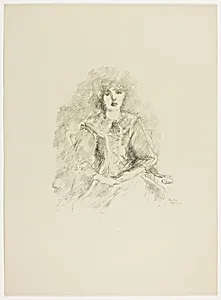
Medium
Transfer lithograph in black on cream wove paper
Dimensions
Image: 78.7 × 15.5 cm (31 × 6 1/8 in.); Sheet: 34.5 × 25.4 cm (13 5/8 × 10 in.)
Classification
lithograph
Department
Prints and Drawings
Museum
Art Institute of Chicago
Accession Number
211078
Rights
Public Domain
Art Historical Context
Theodore Roussel’s “A Study by Lamplight,” created between 1890 and 1894, captures the quiet intimacy of a lamplit scene through the subtle tonal range of a transfer lithograph. Roussel, working in the late nineteenth century, embraced printmaking as a means of artistic expression, producing works that blend observation with atmospheric effect. The narrow, vertical format of the image—roughly thirty-one inches tall yet only six inches wide—invites viewers to linger on delicate contrasts of light and shadow. Transfer lithography allowed artists to draw directly on paper before transferring the image to a printing stone, preserving the spontaneity of the original sketch while enabling multiple impressions. This medium was especially valued during the period for its ability to convey both precision and softness, qualities evident in the cream wove paper’s warm surface. Now housed in the Art Institute of Chicago’s Department of Prints and Drawings, the work exemplifies how print techniques of the era expanded the possibilities of private, contemplative imagery for wider audiences. Visitors can appreciate how the restrained black ink and modest sheet size focus attention on the quiet drama of lamplight, offering a glimpse into Roussel’s interest in everyday moments rendered with technical refinement.
About the Artist
Theodore Roussel · 1847–1926
Theodore Casimir Roussel was born on 23 March 1847 in Lorient, Brittany, France, into a naval family. After serving in the Franco-Prussian War, he began painting in 1872 as an entirely self-taught artist, initially rendering scenes of daily life in the meticulous style of the Old Masters. In 1878, he settled permanently in London, where he immersed himself in the vibrant British art scene. There, ...