
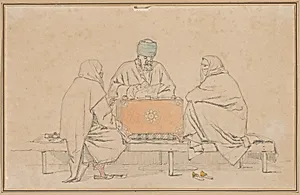
A Turkish Notary and Two Women
1835–36
Medium
Graphite, watercolor
Dimensions
Sheet: 7 1/8 × 11 1/4 in. (18.1 × 28.5 cm)
Classification
Drawings
Department
Drawings and Prints
Museum
Metropolitan Museum of Art, New York, NY
Credit
Harry G. Sperling Fund, 2013
Accession Number
2013.553
Rights
Public Domain
Art Historical Context
Martin Rørbye’s “A Turkish Notary and Two Women” offers a quiet glimpse into daily life in the Ottoman Empire during the artist’s travels in the mid-1830s. with graphite and watercolor on modest sheet, the drawing captures a notary engaged with two women, suggesting an everyday transaction or conversation. Rørbye, a Danish painter associated with the Golden Age, often recorded such scenes while abroad, reflecting the era’s growing European fascination with Eastern cultures. The choice of watercolor and graphite allowed Rørbye to work quickly and with luminous color while traveling. This medium lends the scene both immediacy and delicacy, with soft washes highlighting fabrics and architectural details against the precise pencil lines. As a work on paper rather than a finished oil painting, it reveals the artist’s process of observation and note-taking. Acquired by the Metropolitan Museum in 2013, the drawing invites viewers to consider how 19th-century artists documented foreign customs with both curiosity and respect for the individuals portrayed. Its modest scale encourages close looking, revealing the nuances of dress, gesture, and setting that bring this moment to life.
About the Artist
Martinus Rørbye · 1803–1848
**Martinus Christian Wesseltoft Rørbye (1803–1848) was a Danish painter celebrated for his genre scenes, landscapes, and architectural views, emerging as a central figure in the Danish Golden Age of painting.** Born on 17 May 1803 in Drammen, Norway, to Danish parents, he moved early to Copenhagen and began studies at the Royal Danish Academy of Fine Arts in 1820. There he trained under Christian ...