
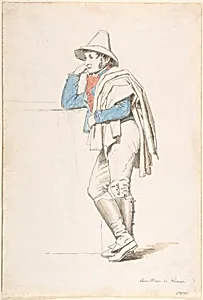
Study of a Roman Coachman
early 19th century
Medium
Graphite and watercolor
Dimensions
sheet: 12 3/4 x 8 5/8 in. (32.4 x 21.9 cm)
Classification
Drawings
Department
Drawings and Prints
Museum
Metropolitan Museum of Art, New York, NY
Credit
Purchase, C. G. Boerner Gift, 2008
Accession Number
2008.371
Rights
Public Domain
Tags
Art Historical Context
Martin Rørbye’s “Study of a Roman Coachman,” created in the early nineteenth century, offers a vivid glimpse into everyday life in Rome through the sensitive medium of graphite and watercolor. The drawing captures a male figure with careful attention to posture, costume and expression, suggesting an artist observing his subject directly from life. At roughly 12¾ by 8⅝ inches, the sheet size is well suited to on-the-spot sketching, allowing the artist to record both the sturdy presence of the coachman and the textures of his clothing with economical yet lively strokes. The combination of graphite and watercolor was especially popular among artists traveling in Italy during this period. Graphite provided crisp outlines and subtle shading, while delicate washes of color could quickly suggest fabric tones or atmospheric light without the commitment of oil paint. Such studies often served as visual notes for larger compositions, yet they also stand alone as intimate records of character and place. Acquired by the Metropolitan Museum of Art in 2008, this work belongs to the museum’s extensive holdings of drawings and prints. It reminds visitors that even seemingly modest sketches can preserve the human details of a distant time and city, inviting us to consider the ordinary faces that once populated Rome’s streets.
About the Artist
Martinus Rørbye · 1803–1848
**Martinus Christian Wesseltoft Rørbye (1803–1848) was a Danish painter celebrated for his genre scenes, landscapes, and architectural views, emerging as a central figure in the Danish Golden Age of painting.** Born on 17 May 1803 in Drammen, Norway, to Danish parents, he moved early to Copenhagen and began studies at the Royal Danish Academy of Fine Arts in 1820. There he trained under Christian ...