
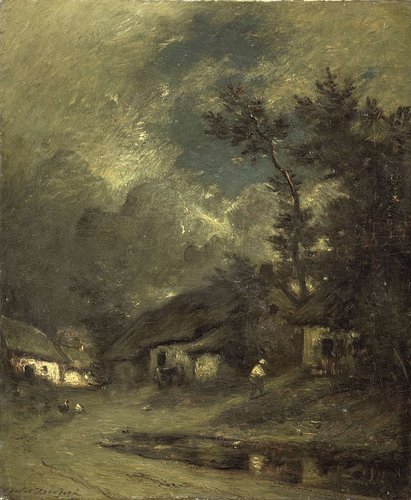
A Village by Night
1840 - 1889
Medium
oil on canvas
Dimensions
10.6; 47.5; 57; 3
Rights
Public Domain
About this artwork
A. van Wezel Bequest, Amsterdam
Art Historical Context
Jules Dupré, a leading member of the Barbizon School, brings quiet drama to the rural landscape in *A Village by Night*. Working in oil on canvas between 1840 and 1889, Dupré favored intimate views of the French countryside, using loose brushwork and rich tonal contrasts to evoke mood rather than precise detail. The modest scale of the painting—57 by 47.5 centimeters—encourages close viewing, drawing attention to the subtle play of moonlight and shadow across village rooftops and fields. Night scenes were still relatively uncommon in mid-nineteenth-century landscape painting, and Dupré’s treatment highlights the Barbizon commitment to painting directly from nature while exploring atmospheric effects. The dark palette and restrained light suggest both the stillness of evening and the artist’s interest in capturing fleeting conditions of weather and time. Acquired by the Rijksmuseum through the A. van Wezel Bequest, the work offers visitors a window onto French realist traditions that influenced later generations of painters across Europe. Its presence in Amsterdam underscores the international appreciation for Barbizon art and the enduring appeal of Dupré’s poetic vision of ordinary places at rest.
About the Artist
Jules Dupré · 1811–1889
Jules Dupré (1811–1889) was born in Nantes, France, on April 5, the son of a porcelain manufacturer. He began his artistic career in his father's factory before moving to paint porcelain at his uncle's china factory in Sèvres. Lacking formal training or a specific teacher, Dupré debuted at the Paris Salon in 1831, earning a second-class medal three years later. A pivotal trip to England in 1834 ex...