
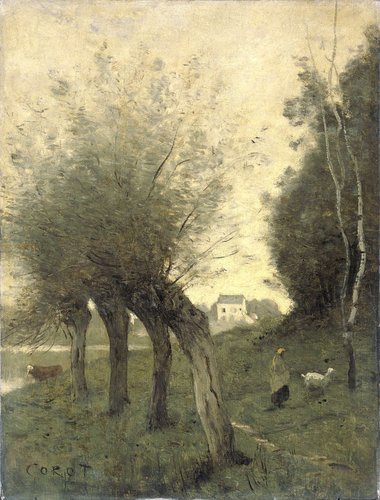
Landscape with Pollard Willows
1840 - 1875
Medium
oil on panel
Dimensions
30.5; 9.5; 40
Rights
Public Domain
About this artwork
A. van Wezel Bequest, Amsterdam
Art Historical Context
Step into the peaceful countryside captured in *Landscape with Pollard Willows* by Jean-Baptiste-Camille Cor, a master of 19th-century French landscape. Created sometime between 1840 and1875, this intimate oil on panel (40 × 30.5 cm) depicts pollard willows—trees deliberately pruned into distinctive, knobby shapes for practical use in rural Europe. Corot's soft, diffused light and subtle tonal harmonies evoke a quiet, poetic atmosphere, hallmarks of his style that bridged Romanticism and the emerging Realism of the Barbizon School. Corot, often called the "poet of light," pioneered plein-air techniques, painting directly from nature to capture fleeting effects of atmosphere and foliage. The compact panel format, prized for its smooth surface, allowed precise layering of glazes that lend the scene a luminous, almost ethereal glow, influencing later Impressionists like Monet. This work reflects his mature period, when he focused on the French countryside after formative travels in Italy. Acquired through the A. van Wezel Bequest and now housed in Amsterdam's Rijksmuseum, it highlights Corot's international appeal. Visitors appreciate how such modest-scale gems distill the timeless beauty of everyday landscapes, inviting quiet contemplation amid the museum's grand collections.
About the Artist
Camille Corot · 1796–1875
Jean-Baptiste-Camille Corot, born in Paris on July 16, 1796, into a prosperous bourgeois family—his father a former wig maker turned draper, his mother a successful milliner—initially resisted his artistic calling. After a lackluster education at the Lycée Pierre-Corneille in Rouen and failed apprenticeships in business, he abandoned commerce at age 26, thanks to a generous parental allowance foll...