
A Young Man Seated, Bent over a Reclining Figure
ca. 1845–50
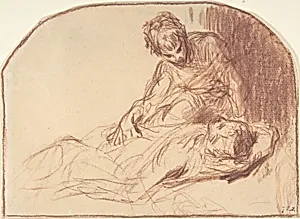
Medium
Red chalk with stumping on laid paper
Dimensions
sheet: 7 3/8 x 10 3/16 in. (18.8 x 25.9 cm) (trimmed at top to form an arch)
Classification
Drawings
Department
Drawings and Prints
Museum
Metropolitan Museum of Art, New York, NY
Credit
Purchase, Mrs. Howard Barnet Gift, 2003
Accession Number
2003.185
Rights
Public Domain
Tags
Art Historical Context
Jean-François Millet’s “A Young Man Seated, Bent over a Reclining Figure” dates from around 1845–50, a formative period before the artist fully embraced the rural subjects that would define his career with the Barbizon school. Millet, who would later become a central figure in the Realist movement, here focuses on the quiet interaction between two men, capturing a moment of care or contemplation that hints at the empathetic view of ordinary people he would develop throughout his work. The drawing is executed in red chalk with stumping on laid paper, a medium prized in the nineteenth century for its ability to render soft, velvety tones and subtle modeling of form. At roughly 7 3/8 by 10 3/16 inches, the sheet was trimmed at the top into an arched shape, suggesting it may once have been part of a larger study or intended for a specific compositional frame. Such intimate figure drawings allowed Millet to explore the human body and emotional expression with directness and sensitivity. Acquired by the Metropolitan Museum of Art in 2003, this work offers a window into Millet’s early practice and the broader shift toward realism in French art, where artists turned their attention from grand historical themes to the quiet dignity of everyday life.
About the Artist
Jean-François Millet · 1814–1875
Jean-François Millet (1814-1875) was a French painter and one of the founders of the Barbizon school, whose dignified depictions of peasant laborers transformed how art could represent rural life. His monumental images of sowers, gleaners, and field workers elevated common people to subjects previously reserved for mythological or historical figures, making him a pivotal figure in the development ...