
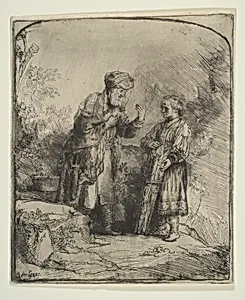
Abraham and Isaac
Medium
Etching, plate tone; first of two states
Dimensions
Plate: 6 1/8 x 5 1/8 in. (15.5 x 13 cm)
Classification
Prints
Department
Drawings and Prints
Museum
Metropolitan Museum of Art, New York, NY
Credit
H. O. Havemeyer Collection, Bequest of Mrs. H. O. Havemeyer, 1929
Accession Number
29.107.26
Rights
Public Domain
Tags
Art Historical Context
In the heart of Rembrandt van Rijn's masterful printmaking oeuvre stands *Abraham and Isaac* (1645), an that captures one of the Bible's most poignant episodes from Genesis 22: the patriarch Abraham preparing to sacrifice his son Isaac at God's command. Created during Rembrandt's mature period in Amsterdam, this work exemplifies the Dutch Baroque master's ability to infuse religious narratives with profound human emotion—Abraham's tense resolve and Isaac's vulnerability rendered with exquisite psychological depth. Rembrandt's etching technique shines here, with intricate drypoint lines and subtle plate tone—a thin film of ink left on the plate—to evoke dramatic chiaroscuro, heightening the scene's tension and intimacy. This first-state impression, before later refinements, offers a raw, experimental quality rare among his prints, showcasing his innovative approach to tonal subtlety on a modest plate measuring just 6 1/8 x 5 1/8 inches. As a pivotal example of 17th-century printmaking, it bridged painting and graphics, allowing wide dissemination of Rembrandt's genius. Housed in The Metropolitan Museum of Art's H. O. Havemeyer Collection, this print invites visitors to ponder themes of faith, obedience, and divine mercy, reminding us why Rembrandt remains a towering figure in art history.
About the Artist
Rembrandt (Rembrandt van Rijn) · 1606–1669
Rembrandt Harmenszoon van Rijn (1606–1669) stands as one of the greatest visual artists in the history of Western art and the most important Dutch painter of the 17th century. Born in Leiden to a prosperous miller's family, Rembrandt transformed painting through his revolutionary use of light and shadow, his psychological depth in portraiture, and his elevation of etching to a fine art. His approx...