
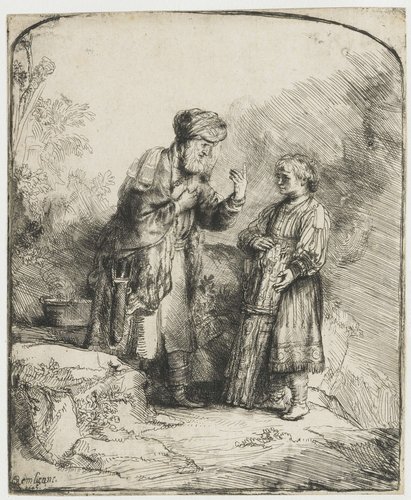
Abraham and Isaac
Medium
etching
Dimensions
157; 130
Rights
Public Domain
About this artwork
opschrift, verso midden onder, potlood: ‘C.J. Wawra - Wien Nov-Dec 1882 - A.L.’
Art Historical Context
Rembrandt van Rijn'sAbraham and Isaac* (1645) is a poignant etching capturing the biblical drama from Genesis 22, where Abraham prepares to sacrifice his son Isaac God's command, only to be halted by divine intervention. Created during the Dutch Golden Age, this small-scale work (157 × mm) exemplifies Rembrandt's mastery of printmaking, blending intense emotional tension with his signature chiaroscuro—deep shadows contrasting luminous highlights to heighten the scene's pathos and humanity. As a Baroque artist renowned for over 300 etchings, Rembrandt innovated with techniques like drypoint and multiple biting of the plate, achieving velvety textures and subtle tonal gradations that rival painting. Here, the figures' expressive faces and dynamic composition draw viewers into the moral dilemma, reflecting 17th-century fascination with faith, obedience, and mercy amid religious turmoil in Europe. A pencil inscription on the verso—"C.J. Wawra - Wien Nov-Dec 1882 - A.L."—hints at its provenance, linking it to a Viennese collector in the late 19th century. This intimate etching remains a testament to Rembrandt's enduring influence, inviting museum visitors to ponder timeless questions of sacrifice and redemption.
About the Artist
Rembrandt van Rijn · 1606–1669
Rembrandt Harmenszoon van Rijn (1606–1669) stands as one of the greatest visual artists in the history of Western art and the most important Dutch painter of the 17th century. Born in Leiden to a prosperous miller's family, Rembrandt transformed painting through his revolutionary use of light and shadow, his psychological depth in portraiture, and his elevation of etching to a fine art. His approx...