
Abraham Entertaining the Angels
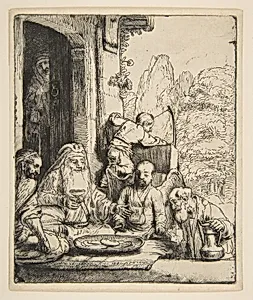
Medium
Etching with drypoint, very light plate tone
Dimensions
sheet: 6 1/2 x 5 7/16 in. (16.5 x 13.8 cm) plate: 6 1/4 x 5 3/16 in. (15.9 x 13.2 cm)
Classification
Prints
Department
Drawings and Prints
Museum
Metropolitan Museum of Art, New York, NY
Credit
Gift of Henry Walters, by exchange, 1923
Accession Number
23.51.8
Rights
Public Domain
Tags
Art Historical Context
In 1656, Rembrandt van Rijn, the Dutch Baroque master renowned for his profound biblical narratives and innovative printmaking, created *Abraham Entertaining the Angels This etching with drypoint captures a pivotal moment from Genesis 18, where the patriarch Abraham welcomes three divine visitors—interpreted as angels—at the entrance of his tent. The intimate scale (plate: 6 1/4 x 5 3/16 in.) draws viewers into scene rich with hospitality, foreshadowing the miraculous birth of Isaac, blending everyday warmth with spiritual mystery. Rembrandt's etching technique shines here: fine lines etched into a copper plate, enhanced by drypoint's velvety burr for rich textures and subtle shading, plus a very light plate tone evoking a hazy, ethereal glow. As one of his late prints, it exemplifies his shift toward looser, more expressive marks, achieving dramatic light effects and emotional depth on a small surface—hallmarks of his genius that influenced generations of printmakers. Housed in the Metropolitan Museum of Art's Drawings and Prints department (gift of Henry Walters, 1923), this work highlights Rembrandt's enduring fascination with Old Testament themes, inviting reflection on faith, divine encounters, and human generosity across cultures. A gem for print enthusiasts!
About the Artist
Rembrandt (Rembrandt van Rijn) · 1606–1669
Rembrandt Harmenszoon van Rijn (1606–1669) stands as one of the greatest visual artists in the history of Western art and the most important Dutch painter of the 17th century. Born in Leiden to a prosperous miller's family, Rembrandt transformed painting through his revolutionary use of light and shadow, his psychological depth in portraiture, and his elevation of etching to a fine art. His approx...