
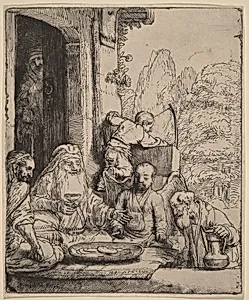
Abraham Entertaining the Angels
Medium
etching and drypoint on laid paper
Dimensions
plate: 15.9 x 13.2 cm (6 1/4 x 5 3/16 in.) sheet: 16.2 x 13.5 cm (6 3/8 x 5 5/16 in.)
Classification
Department
CG-E
Museum
National Gallery of Art, Washington, D.C.
Credit
Rosenwald Collection
Accession Number
1943.3.7160
Rights
Public Domain
Art Historical Context
In the intimate etching *Abraham Entertaining the Angels* (1656), Rembrandt van Rijn captures a pivotal biblical moment from Genesis 18, where the patriarch Abraham welcomes three heavenly visitors—angels in disguise—who foretell the birth of his son Isaac. Created late in Rembrandt's career, this small-scale print (plate measures just 15.9 x 13.2 cm) exemplifies the Dutch master's profound ability to infuse spiritual narratives with human warmth and drama, characteristic of his Baroque style. The scene brims with tender hospitality: Abraham gestures welcomingly, while Sarah peeks curiously from the tent, highlighting themes of faith, divine promise, and everyday miracle. Rembrandt's virtuoso use of etching and drypoint on laid paper produces extraordinary effects of light and texture. Etching allows precise lines for architectural details and figures, while drypoint's burr creates velvety richness in shadows and folds of clothing, drawing viewers into the scene's glowing hearth and ethereal auras. As part of the National Gallery of Art's Rosenwald Collection, this print showcases Rembrandt's innovation in printmaking, where he pushed the medium toward painterly depth, making it rival oil paintings in emotional impact. Housed in the museum's Prints department (CG-E classification), the work reflects 17th-century Northern Europe's fascination with Old Testament stories amid religious turmoil. Its modest size invites close contemplation, revealing Rembrandt's genius for storytelling through subtle expression and masterful light—perfect for pondering divine encounters in our own lives.
About the Artist
Rembrandt van Rijn · 1606–1669
Rembrandt Harmenszoon van Rijn (1606–1669) stands as one of the greatest visual artists in the history of Western art and the most important Dutch painter of the 17th century. Born in Leiden to a prosperous miller's family, Rembrandt transformed painting through his revolutionary use of light and shadow, his psychological depth in portraiture, and his elevation of etching to a fine art. His approx...