
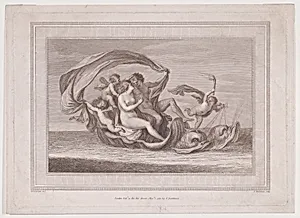
Acis and Galathea
Medium
Etching and engraving, printed in color; third state of three
Dimensions
Plate: 8 15/16 × 12 11/16 in. (22.7 × 32.2 cm) Sheet: 9 11/16 × 13 3/8 in. (24.6 × 34 cm)
Classification
Prints
Department
Drawings and Prints
Museum
Metropolitan Museum of Art, New York, NY
Credit
Harris Brisbane Dick Fund, 1917
Accession Number
17.3.394
Rights
Public Domain
Art Historical Context
This vibrant color print captures the tender mythological romance of Acis and Galatea, a tale from Ovid’s Metamorphoses in which the sea nymph Galatea falls in love with the shepherd Acis, only for the jealous cyclops Polyphemus to intervene. Created on March 1, 1787, the work represents a collaboration between designer Giovanni Battista Cipriani and master printmaker Francesco Bartolozzi, both Italian artists active in Britain during the late eighteenth century. Their partnership helped popularize refined, decorative imagery drawn from classical sources for an expanding audience of collectors and connoisseurs. Executed in etching and engraving and printed in color during the third and final state, the print showcases Bartolozzi’s pioneering stipple technique, which allowed subtle tonal gradations and luminous hues to be achieved directly on the plate rather than through hand-coloring. Measuring just under nine by thirteen inches, the intimate scale made such works affordable luxuries that brought elegant neoclassical taste into private homes. As part of the Metropolitan Museum’s holdings in the Department of Drawings and Prints, this sheet reflects the era’s growing interest in reproductive prints as vehicles for disseminating both artistic innovation and classical ideals across Europe and beyond.
About the Artist
Francesco Bartolozzi|Giovanni Battista Cipriani|Francesco Bartolozzi · 1727–1815
Francesco Bartolozzi (1727–1815) was an Italian engraver whose most productive period was spent in London, where he became the leading exponent of stipple engraving and a founding member of the Royal Academy. Born in Florence and trained first as a painter before turning to engraving in Venice, he established his reputation in Rome before being recruited by the English Royal Librarian Richard Dalt...