
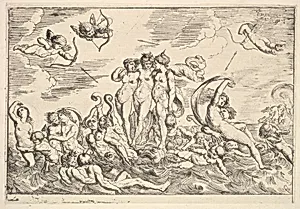
Triumph of Galatea
1610–42
Medium
Etching
Dimensions
Sheet: 4 13/16 x 6 15/16 in. (12.3 x 17.7cm)
Classification
Prints
Department
Drawings and Prints
Museum
Metropolitan Museum of Art, New York, NY
Credit
Harris Brisbane Dick Fund, 1928
Accession Number
28.28.1
Rights
Public Domain
Tags
Art Historical Context
Welcome to the Metropolitan Museum of Art's Drawings and Prints collection, where Pierre Brebiette's *Triumph of Galatea* (c. 1610–42) captivates with its delicate etching technique. This intimate print, measuring just 4 13/16 x 6 15/16 inches, showcases Brebiette's skill as a French engraver during the early Baroque era. Etching, popular in the 17th century for its precision and tonal richness, allowed artists like Brebiette to create intricate lines with acid on a metal plate, producing editions that spread mythological imagery far beyond grand canvases. The title evokes the ancient myth of Galatea, the beautiful sea nymph pursued by the cyclops Polyphemus but beloved by the shepherd Acis. Here, tags highlight Cupid with his bow and arrow, suggesting a triumphant scene of love's victory amid swirling figures and dynamic composition. Brebiette's work reflects the era's fascination with classical tales from Ovid's *Metamorphoses*, blending elegance and emotion in a compact format ideal for collectors. Acquired through the Harris Brisbane Dick Fund in 1928, this etching exemplifies how prints democratized art, making grand narratives accessible. Gaze closely to appreciate the fine lines that bring Galatea's triumph to life—a testament to 17th-century ingenuity.
About the Artist
Pierre Brebiette · 1598–1642
Pierre Brébiette (c. 1598–c. 1642) was a French painter and etcher whose elegant, sensuous treatment of classical mythology and allegory earned him a significant reputation in early seventeenth-century Paris. Born in Mantes-sur-Seine, Brébiette traveled to Italy as a young man and lived and worked in Rome from around 1617 to approximately 1625, absorbing the influences of ancient sculpture, Renais...