
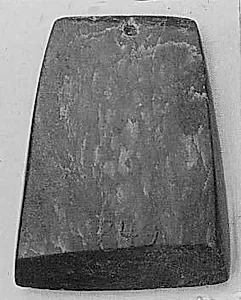
Adze
Unknown Artist
Medium
Nephrite
Dimensions
H. 2 1/16 in. (5.3 cm); W. 1 5/8 in. (4.2 cm); D. 3/8 in. ( 1 cm)
Classification
Jade
Culture & Period
North America (Alaska, Chatham Island) · Prehistoric
Department
Asian Art
Museum
Metropolitan Museum of Art, New York, NY
Credit
Gift of Heber R. Bishop, 1902
Accession Number
02.18.249
Rights
Public Domain
Art Historical Context
This compact nephrite adze, hailing from prehistoric North America—specifically Alaska's Chatham Island—offers a glimpse into the ingenuity of ancient indigenous peoples. Measuring just over 2 inches tall, 1.5 inches wide, and less than half an inch thick, this handheld tool was essential for woodworking, shaping canoes, totem poles, and other cultural artifacts vital to Northwest Coast societies. Its prehistoric origins underscore a time before European contact, when communities thrived on masterful craftsmanship tied to their environment. Crafted from nephrite, a dense and exceptionally tough form of jade, the adze exemplifies the material's significance in tool-making. Nephrite's durability allowed it to hold a sharp edge far longer than wood or bone alternatives, making it ideal for heavy use while being laboriously polished to a smooth, lustrous finish—a testament to skilled stoneworking techniques. Prized for both utility and prestige, such jade tools were often traded across vast distances, highlighting interconnected indigenous networks. A generous gift from Heber R. Bishop in 1902, this piece resides in the Metropolitan Museum of Art's Asian Art Department, reflecting early 20th-century collecting interests in global jades. Though small, it embodies the enduring cultural legacy of Alaska's first peoples.