
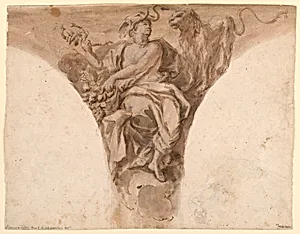
Africa, Design for a Pendentive in the Baptismal Vestibule of St. Peter’s, Rome
Classification
interiors
Department
Smithsonian Collection
Museum
Smithsonian American Art Museum
Credit
Museum purchase through gift of various donors
Accession Number
1901-39-1699
Rights
Public Domain
About this artwork
Research in Progress
Art Historical Context
Francesco Trevisani (1656–1746), a prominent Italian Baroque artist active in Rome, created this design titled *Africa* between 1713 and 1726 as a preparatory study for a pendentive in the Baptismal Vestibule of St. Peter’s Basilica. Pendentives are the curved triangular sections of vaulting that transition from a square base to a circular dome, often adorned with symbolic frescoes or mosaics in grand ecclesiastical architecture. Trevisani’s work likely formed part of a decorative scheme representing the four continents—Europe, Asia, Africa, and America—emphasizing the Catholic Church’s global reach during the height of the Baroque era. As a design for one of the world’s most iconic sacred spaces, this piece reflects the opulent vision of St. Peter’s, rebuilt under papal patronage to inspire awe and devotion. Trevisani, known for his elegant, luminous figures and refined Rococo influences emerging from late Baroque traditions, would have captured Africa through allegorical motifs, perhaps evoking exotic landscapes or virtues tied to the continent. Though the medium remains unidentified amid ongoing research, such studies were crucial for coordinating large-scale interior decorations. Housed in the Smithsonian American Art Museum through donor gifts, this artwork offers a glimpse into 18th-century Roman artistry and the interplay of faith, empire, and aesthetics in Vatican commissions. It invites visitors to imagine the vibrant vestibule alive with Trevisani’s graceful compositions.