
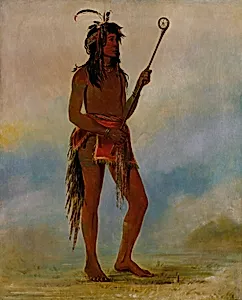
Ah-nó-je-nahge, He Who Stands on Both Sides, a Distinguished Ball Player
1835
Medium
Painting
Classification
Painting
Department
Smithsonian Collection
Museum
Smithsonian American Art Museum
Credit
Smithsonian American Art Museum, Gift of Mrs. Joseph Harrison, Jr.
Accession Number
1985.66.74
Rights
Public Domain
Tags
About this artwork
“The two most distinguished ball-players in the Sioux tribe [see also 1985.66.75] . . . Both of these young men stood to me for their portraits, in the dresses precisely in which they are painted; with their ball-sticks in their hands, and in the attitudes of the play. We have had several very spirited plays here within the past few days; and each of these young men came from the ball-play ground to my painting-room, in the dress in which they had just struggled in the play.” George Catlin saw S...
Art Historical Context
In 1835, George Catlin captured the dynamic likeness of Ah-nó-je-nahge, a ball player from the Sioux (Dakota) tribe, in this full-length portrait painted at Fort Snelling in present-day Minnesota. Catlin, renowned for his extensive documentation of Native American life, sketched the young athlete directly from life, moments after an intense lacrosse game. Dressed in his playing attire with ball-stick in hand and poised in mid-action, Ah-nó-je-nahge embodies the vigor and skill of Sioux stickball, a traditional game akin to lacrosse played by tribes across North America. Catlin noted fascinating cultural details: unlike the Choctaw, who used two sticks and horsehair tails, Sioux players wielded one stick and adorned their regalia with quills. This painting, part of a pair highlighting top Sioux players, preserves a vivid snapshot of indigenous athletic traditions amid rapid cultural changes in the 1830s, as European settlement encroached on Native lands. Catlin's on-site approach ensured authenticity, making the work a valuable ethnographic record. Today, housed in the Smithsonian American Art Museum, this oil painting celebrates not just individual prowess but the communal spirit of Sioux ball play—energetic contests that fostered tribal bonds and physical excellence.
About the Artist
George Catlin · 1796–1872
George Catlin (1796–1872), born in Wilkes-Barre, Pennsylvania, to Putnam Catlin and Polly Sutton—who had been captured by Native Americans during the 1778 Battle of Wyoming—initially pursued a legal career. Trained at Litchfield Law School, he was admitted to the bar in 1819 but abandoned law after two years to study art in Philadelphia in 1823. Self-taught as a portraitist, Catlin quickly gained ...