
Allegory of Life
1561
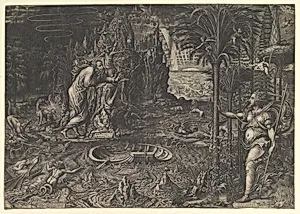
Medium
Engraving; second state of six (BLL)
Dimensions
Sheet (Trimmed): 14 15/16 × 21 1/4 in. (38 × 54 cm)
Classification
Prints
Department
Drawings and Prints
Museum
Metropolitan Museum of Art, New York, NY
Credit
Gift of Harry G. Friedman, 1962
Accession Number
62.635.175
Rights
Public Domain
Tags
Art Historical Context
Giorgio Ghisi’s *Allegory of Life* (1561) is a masterful engraving that captures the imaginative spirit of late-Renaissance Mannerism. Working in Mantua and later in France, Ghisi specialized in translating complex painted compositions into finely detailed prints. Here he populates a wooded landscape with men, women, and satyrs amid animals, inviting viewers to ponder the stages and temptations of human existence. As an engraving—the most important reproductive medium of the sixteenth century—this work allowed allegorical imagery to travel across Europe, reaching collectors and artists who might never see the original design. The second state of six shows Ghisi’s careful attention to tonal nuance, achieved through precise cross-hatching that gives volume to figures and depth to the foliage. Today housed in the Metropolitan Museum of Art, the print exemplifies how Renaissance engravers turned philosophical themes into accessible works of art, blending classical mythology with moral reflection for a widening audience.
About the Artist
Giorgio Ghisi · 1520–1582
Giorgio Ghisi (c. 1520–1582) was one of the most accomplished engravers of the Italian Renaissance, renowned for translating the monumental compositions of Raphael, Giulio Romano, and Michelangelo into the exacting medium of the burin. Born in Mantua, he trained in an environment shaped by the legacy of Giulio Romano's decoration of the Palazzo del Te, and the grandeur of that Mannerist tradition ...