
Allegory of Life
1561
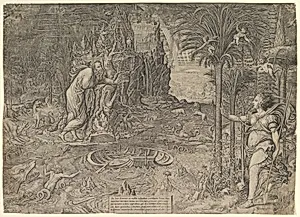
Medium
Engraving; sixth state of six (BLL)
Dimensions
Sheet: 15 3/16 in. × 21 in. (38.5 × 53.4 cm)
Classification
Prints
Department
Drawings and Prints
Museum
Metropolitan Museum of Art, New York, NY
Credit
Bequest of Grace M. Pugh, 1985
Accession Number
1986.1180.221
Rights
Public Domain
Tags
Art Historical Context
Giorgio Ghisi’s *Allegory of Life* (1561) is a masterful engraving that captures the symbolic richness of mid-sixteenth-century Italian printmaking. Working in Mantua during the late Renaissance, Ghisi specialized in intricate reproductive engravings that translated paintings and designs into widely accessible images. This sixth and final state demonstrates his refined technique, with delicate line work and tonal gradations that bring depth to the composition featuring men, women, and birds. The print’s allegorical theme reflects the period’s fascination moral and philosophical ideas about human existence. Birds often symbolized the soul or fleeting time in Renaissance imagery, while the human figures likely represent stages of life or virtues and vices. As an engraving, the work could be printed in multiple impressions, allowing such complex ideas to circulate beyond elite circles and reach a broader audience across Europe. Housed in the Metropolitan Museum of Art’s Department of Drawings and Prints, this sheet measuring roughly 15 by 21 inches showcases the enduring power of printmaking to preserve and share cultural narratives. Its bequest to the museum in 1985 ensures that visitors today can appreciate Ghisi’s skill in blending technical precision with thoughtful symbolism.
About the Artist
Giorgio Ghisi · 1520–1582
Giorgio Ghisi (c. 1520–1582) was one of the most accomplished engravers of the Italian Renaissance, renowned for translating the monumental compositions of Raphael, Giulio Romano, and Michelangelo into the exacting medium of the burin. Born in Mantua, he trained in an environment shaped by the legacy of Giulio Romano's decoration of the Palazzo del Te, and the grandeur of that Mannerist tradition ...