
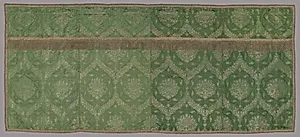
Altar Frontal
Second half of 16th century
Medium
Silk and gilt-metal-strip-wrapped silk, 4:1 satin damask weave with supplementary brocading wefts bound by main warps in weft-float faced 1:4 's' interlacing; edged with gilt-metal-strip-wrapped silk, plain weave with supplementary patterning warps and extended ground weft uncut fringe and silk, gilt-metal-strip and gilt-metal-strip-wrapped silk, stripes of plain weave with supplementary patterning warps and of 2:2 'z' twill weave with extended ground weft, wrapped, knotted uncut fringe; lining: silk, plain weave
Dimensions
100.6 × 124.1 cm (39 5/8 × 88 1/4 in.); Repeat: 56 × 28.2 cm (22 × 11 1/8 in.)
Classification
textile
Department
Textiles
Museum
Art Institute of Chicago
Accession Number
86774
Rights
Public Domain
About this artwork
Expensive silk and gold textiles featured prominently in the decoration used in European Catholic churches. Because of their cost, precious materials were often recycled and refashioned. This 16th-century textile altar frontal has been augmented with more recent fringe and trimmings around the perimeter. The placement of these new elements echo the style of 16th-century frontals; they may have replaced originals that had become unsightly with age.
About the Artist
Unknown
The artist designated as "Unknown" in our virtual museum's collection exemplifies a poignant chapter in art history: creators whose identities have faded into obscurity despite the enduring power of their work. With only one known artwork attributed to them in our holdings, this figure represents countless anonymous hands that shaped visual culture across centuries. Museums worldwide, including th...