
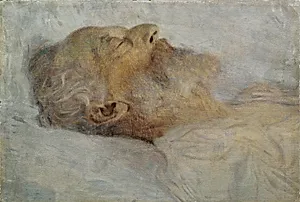
Alter Mann auf dem Totenbett
1900
Medium
Öl auf Malpappe
Dimensions
30,4 × 44,8 cm
Classification
Gemälde
Department
Belvedere Collection
Museum
Belvedere
Credit
Belvedere, Vienna
Accession Number
8507
Rights
Public Domain
About this artwork
Totendarstellungen tauchen in Klimts Schaffen immer wieder auf, doch werden sie aufgrund der sehr persönlichen Thematik selten der Öffentlichkeit präsentiert. Meist sind die dargestellten Personen eindeutig zu identifizieren. Nicht so im Fall dieses Bildnisses, bei dem die Identität des alten Mannes nicht restlos geklärt ist und der Forschung nach wie vor Rätsel aufgibt. Oftmals fertigt Klimt die Darstellungen unmittelbar nach dem Tod der Personen an, gelegentlich sogar noch am Tag des Ablebens....
Art Historical Context
Gustav Klimt's *Alter Mann auf dem Totett* (Old Man on the Deathbed), painted in 1900, offers a haunting glimpse into the artist's private explorations of mortality. Created in oil on cardboard—a modest, intimate medium atypical for Klimt's more opulent gold-leaf masterpieces—this small work (30.4 × 44.8 cm) a poignant moment of human fragility. Housed in Vienna's Belvedere Collection, reflects Klimt's affiliation with the Vienna Secession, where he blended Symbolism with psychological depth, though these deathbed portraits remained largely hidden from public view due to their intensely personal nature. Death motifs recur throughout Klimt's oeuvre, often rendered with unflinching immediacy—sometimes on the very day of the subject's passing. Here, the elderly man's identity eludes scholars, adding an air of mystery that continues to intrigue researchers. The painting's 1900 date likely marks the year of his death, underscoring Klimt's ritual of memorializing the recently departed. Notably, the composition appears cropped, presenting only a fragment of its original scope, which heightens its raw, unfinished intimacy. This rare survivor invites visitors to ponder life's transience through Klimt's empathetic gaze, bridging his public sensuality with profound private reflection. A testament to early 20th-century Viennese introspection, it reminds us of the artist's versatility beyond iconic portraits like *The Kiss*.
About the Artist
Gustav Klimt · 1862–1918
Gustav Klimt was born on July 14, 1862, in Baumgarten near Vienna, the second of seven children in a modest family of artistic bent. His father, Ernst Klimt, a gold engraver who had immigrated from Bohemia, and his mother, Anna Finster, an aspiring musician, instilled an early appreciation for craft and creativity amid financial hardship. Klimt displayed prodigious drawing talent, prompting his en...