
Amulet of a Lion-Headed Cobra
Ptolemaic Period–Roman Period, 4th century BCE–4th century CE
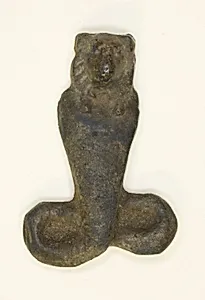
Medium
Faience
Dimensions
3.2 × 2.1 × 0.8 cm (1 5/16 × 7/8 × 3/8 in.)
Classification
amulet
Department
Arts of Africa
Museum
Art Institute of Chicago
Accession Number
141260
Rights
Public Domain
About this artwork
With the body of a rearing cobra and the head of a ferocious lion, this faience amulet is small but mighty. During the mummification process, amulets like this one were folded into the linen wrappings of a body to protect the deceased. Such objects often depicted gods and goddesses in their human, animal, or mixed forms. This amulet likely represents a goddess—either Sekhmet or Wadjet—but because the image is not inscribed with a name, her identity remains uncertain. Sekhmet typically is depict...
About the Artist
Ancient Egyptian
Ancient Egyptian artists, a collective of highly skilled artisans spanning over three millennia from the Predynastic period (c. 6000–3150 BC) to the Roman era (30 BC–4th century AD), produced some of humanity's most enduring masterpieces. These anonymous craftsmen, often organized in state-sponsored workshops, lived in dedicated communities like Deir el-Medina near Luxor during the New Kingdom (c....