
An Egyptian Peasant Woman and Her Child
1869–70
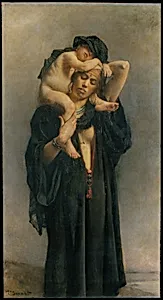
Medium
Oil on canvas
Dimensions
73 1/2 x 41 1/2 in. (186.7 x 105.4 cm)
Classification
Paintings
Department
European Paintings
Museum
Metropolitan Museum of Art, New York, NY
Credit
Catharine Lorillard Wolfe Collection, Bequest of Catharine Lorillard Wolfe, 1887
Accession Number
87.15.97
Rights
Public Domain
Tags
Art Historical Context
Léon Bonnat's *An Egyptian Peasant Woman and Her Child* (1869–70) is a striking oil-on-canvas portrait measuring over six feet tall, capturing an intimate moment of maternal tenderness amid everyday life. The French academic painter, renowned for his realistic portrayals of human subjects, renders the woman and child with lifelike detail—her weathered face and simple attire evoking the resilience of rural Egypt. This large-scale work exemplifies Bonnat's mastery of oil, using rich earth tones and subtle modeling to convey texture in fabric and skin, drawing viewers into a sense of quiet dignity. Created during the height of 19th-century Orientalism, the painting reflects Europe's romantic fascination with the "exotic" East. Bonnat, influenced by his travels, presents an idealized yet grounded vision of Egyptian peasantry, blending Realism's attention to detail with Orientalist tropes of women and children as symbols of cultural otherness. Such works fueled Western imaginations while often simplifying complex realities. Now in the Metropolitan Museum of Art's European Paintings department, thanks to the Catharine Lorillard Wolfe Collection (1887), it invites reflection on colonialism's artistic gaze and timeless themes of family. A poignant window into Bonnat's era, it celebrates human connection across cultures.
About the Artist
Léon Bonnat · 1833–1922
**Léon Joseph Florentin Bonnat** (1833–1922) was a prominent French painter, renowned portraitist, art collector, and influential professor at the École des Beaux-Arts. Born in Bayonne, he spent his formative years from 1846 to 1853 in Madrid, where his father ran a bookshop. There, while assisting in the family business, he copied engravings after Old Masters and received training under the Spani...