
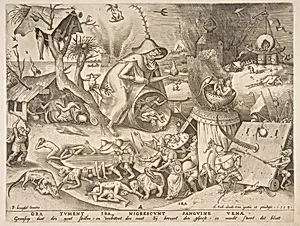
Anger (Ira) from The Seven Deadly Sins
Medium
Engraving
Dimensions
plate: 8 13/16 x 11 9/16 in. (22.4 x 29.4 cm) sheet: 10 1/4 x 13 1/4 in. (26.1 x 33.6 cm)
Classification
Prints
Department
Drawings and Prints
Museum
Metropolitan Museum of Art, New York, NY
Credit
Harris Brisbane Dick Fund, 1928
Accession Number
28.4(31)
Rights
Public Domain
Tags
Art Historical Context
"Anger (Ira)" is a captivating engraving from Pieter Bruegel the Elder's renowned series *The Seven Deadly Sins*, in 1558. by the innovative Flemish artist Bruegel, known for his Northern Renaissance style blending intricate detail with moral satire, it was masterfully engraved by Pieter van der Hey and published by Hieronym Cock. This print vividly captures the chaos of wrath, featuring soldiers locked in brutal combat amid a landscape of destruction—weapons clashing and figures consumed by rage—serving as a stark warning against one of humanity's primal vices. Bruegel's series, produced during the turbulent Reformation era in the Netherlands, drew on medieval Christian theology to critique societal flaws through bustling, everyday scenes elevated to universal allegory. Engravings like this one were revolutionary for their time, allowing affordable reproduction and wide dissemination of complex ideas to a broad audience beyond the elite. Measuring about 9 by 12 inches on the plate, this work exemplifies the precision of 16th-century printmaking, where van der Heyden's burin etched Bruegel's dynamic compositions into copper, preserving fine lines and textures. Housed in the Metropolitan Museum of Art's Drawings and Prints department, it remains a testament to how art could provoke reflection on human nature amid religious and social upheaval.
About the Artist
Pieter Bruegel the Elder|Pieter van der Heyden|Hieronymus Cock · 1525–1569
Pieter Bruegel the Elder, a pioneering Netherlandish painter of the Renaissance, was born around 1525–1530, likely in Breda in the Duchy of Brabant (present-day Netherlands). Little is known of his early family background, but he apprenticed under the Antwerp painter and designer Pieter Coecke van Aelst between approximately 1545 and 1550, mastering tapestry design, architecture, and painting tech...