
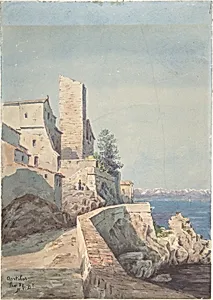
Antibes
Medium
watercolor
Dimensions
Sheet: 12 3/4 x 9 5/8 in. (32.4 x 24.5cm)
Classification
Drawings
Department
Drawings and Prints
Museum
Metropolitan Museum of Art, New York, NY
Credit
Bequest of H.V. Burgy, 1901
Accession Number
01.23.177
Rights
Public Domain
Tags
Art Historical Context
**Antibes** (1882) by Henry Victorgy is a delicate watercolor capturing the architectural charm of Antibes, a picturesque fortified town on France's Côte d'Azur. Created in the late 19th century this work reflects the era's growing fascination with Mediterranean landscapes among European artists, who traveled to capture sun-drenched scenes. Burgy's sheet-sized drawing (12 3/4 x 9 5/8 in.) invites viewers into Antibes' historic ramparts and harbor views, evoking the town's role as a vibrant seaport with roots in Roman and medieval times. Watercolor's translucent qualities shine here, allowing Burgy to layer subtle tones that suggest shimmering light and atmospheric depth—ideal for architectural subjects. Classified as a drawing in the Metropolitan Museum of Art's Drawings and Prints department, it exemplifies the medium's portability for on-site sketching, a common practice for artists documenting travel impressions before photography dominated. Acquired through H.V. Burgy's own bequest in 1901, this piece offers a personal window into 1880s France, blending technical finesse with evocative simplicity. A gem for architecture enthusiasts, it reminds us how watercolors preserve fleeting moments of cultural heritage.
About the Artist
Henry Victor Burgy · 1801–1901
Henry Victor Burgy (1801–1901) was a French painter whose serene landscapes capture the luminous beauty of southern France and historic châteaux in the late nineteenth century. Little is known about his early life or formal training, as biographical details remain scarce in art historical records. Active primarily in his later decades, Burgy produced works that reflect a personal affinity for coas...