
Antonio Zingano
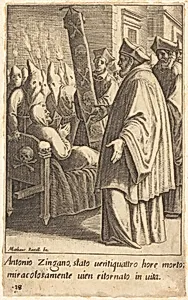
Medium
engraving on laid paper
Dimensions
sheet (trimmed to plate mark): 13.2 × 8.2 cm (5 3/16 × 3 1/4 in.)
Classification
Department
CG-E
Museum
National Gallery of Art, Washington, D.C.
Credit
R.L. Baumfeld Collection
Accession Number
1969.15.311
Rights
Public Domain
Art Historical Context
This engraving, created in 1619 by Jacques Callot after a design by Matteo Rosselli, captures the refined portraiture of the early Baroque period. Callot, a master printmaker from Lorraine, was renowned for his precise line work and ability to translate paintings into widely accessible prints. Working in Florence at the time, he frequently collaborated with Italian artists like Rosselli, helping to spread their compositions across Europe through the medium of engraving on laid paper. Prints like this one played a vital cultural role in the seventeenth century, allowing images of notable figures—here, the subject Antonio Zingano—to reach audiences far beyond the original painting’s location. The small scale, just over five inches tall, made it ideal for personal collections or inclusion in books, reflecting the growing popularity of affordable art during this era. Today, the work resides in the National Gallery of Art’s collection as part of the R.L. Baumfeld bequest, offering visitors a glimpse into the collaborative world of Baroque artists and the enduring power of printmaking to preserve and share history.