
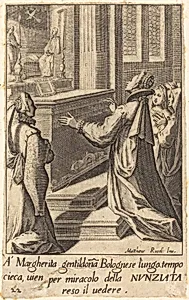
Margherita
Medium
engraving on laid paper
Dimensions
sheet ([irreg.] trimmed to plate mark): 13.4 × 8.4 cm (5 1/4 × 3 5/16 in.)
Classification
Department
CG-E
Museum
National Gallery of Art, Washington, D.C.
Credit
R.L. Baumfeld Collection
Accession Number
1969.15.320
Rights
Public Domain
Art Historical Context
This engraving titled "Margherita," created in 1619 by Jacques Callot after a design by the Italian painter Matteo Rosselli, offers a glimpse into early 17th-century artistic exchange between France and Italy. At just 13.4 by 8.4 centimeters, the intimate scale on laid paper highlights the precision possible in engraving, a technique that allowed Callot to translate Rosselli’s original composition into fine, detailed lines suitable for reproduction. Jacques Callot, renowned for his innovative printmaking during the Baroque period, frequently produced such works while active in Italy. Reproductive engravings like this one played a vital role in spreading artistic ideas and images across Europe at a time when original paintings remained largely in private or ecclesiastical hands. The medium’s ability to capture subtle textures and expressions made it especially valued for portraits and figure studies. Now part of the National Gallery of Art’s collection through the R.L. Baumfeld gift, the print exemplifies how graphic arts bridged painting and wider audiences, preserving the likeness of its subject for centuries.