
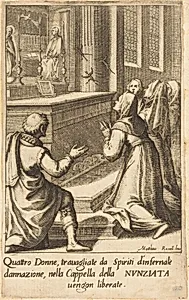
Four Women
Medium
engraving on laid paper
Dimensions
sheet (trimmed to plate mark): 13.5 × 8.5 cm (5 5/16 × 3 3/8 in.)
Classification
Department
CG-E
Museum
National Gallery of Art, Washington, D.C.
Credit
R.L. Baumfeld Collection
Accession Number
1969.15.338
Rights
Public Domain
Art Historical Context
This delicate engraving titled *Four Women*, created in 1619 by Jacques Callot after a design by the Italian painter Matteo Rosselli, captures the refined artistic exchange between France and Italy in the early Baroque era. Measuring just 13.5 by 8.5 centimeters, the small print on laid paper demonstrates Callot’s precise engraving technique, which allowed intricate lines and subtle tonal variations to convey texture and form. As a reproductive work, it translates Rosselli’s original composition into a format that could be widely circulated, reflecting the growing importance of prints in sharing artistic ideas across Europe. Callot, renowned for his technical innovations in printmaking, brought a distinctive clarity and liveliness to the figures of the four women. The medium of engraving on laid paper was especially valued during this period for its durability and ability to produce multiple impressions, making art more accessible beyond courtly or ecclesiastical circles. Though the exact narrative remains open to interpretation, the composition likely draws from allegorical, mythological, or genre subjects popular in early seventeenth-century Florence and France. Now part of the National Gallery of Art’s R.L. Baumfeld Collection, this print offers visitors a glimpse into the collaborative nature of Baroque art production and the enduring appeal of finely crafted engravings.