
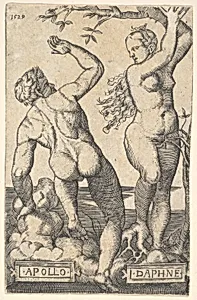
Apollo and Daphne (reverse copy)
n.d.
Medium
Engraving
Dimensions
Sheet: 3 1/8 in. × 2 in. (7.9 × 5.1 cm)
Classification
Prints
Department
Drawings and Prints
Museum
Metropolitan Museum of Art, New York, NY
Credit
Gift of Harry G. Friedman, 1962
Accession Number
57.658.34
Rights
Public Domain
Tags
Art Historical Context
This small engraving by Barthel Beham captures the dramatic moment from classical mythology when the nymph Daphne transforms into a laurel tree to escape the pursuing god Apollo. Created as a reverse copy—an intentional mirror image of another composition—the work reflects the Renaissance fascination with Ovid’s tales and the technical possibilities of printmaking. Beham, a German artist associated with the so-called “Little Masters,” specialized in finely detailed engravings on a miniature scale, allowing intricate narratives to fit within just a few inches. Engravings like this one played a vital role in spreading mythological imagery across Europe during the sixteenth century. Because prints could be produced in multiples and easily transported, they made classical stories accessible beyond the walls of palaces and churches. The compact size of this sheet (roughly the dimensions of a modern playing card) highlights the remarkable precision required of the medium, where every line had to convey movement, emotion, and texture. Today in the Metropolitan Museum’s collection, the engraving invites close looking. Its subject and delicate technique together demonstrate how Renaissance artists blended ancient stories with innovative printmaking to create intimate works of art meant for personal study and delight.
About the Artist
Barthel Beham · 1502–1540
Barthel Beham (1502–1540), a pivotal figure in the German Renaissance, was born in Nuremberg into a family of artists. The younger brother of the renowned engraver Hans Sebald Beham, he honed his craft under the tutelage of his elder sibling and the master Albrecht Dürer, absorbing the precise techniques of engraving and painting that defined Nuremberg's vibrant artistic scene. Emerging as a prodi...