
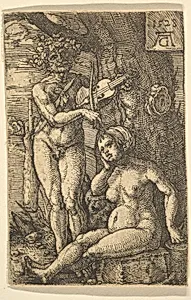
Orpheus and Eurydice
Medium
Etching from iron plate
Dimensions
sheet: 3 1/16 x 2 1/16 in. (7.8 x 5.2 cm)
Classification
Prints
Department
Drawings and Prints
Museum
Metropolitan Museum of Art, New York, NY
Credit
Harris Brisbane Dick Fund, 1932
Accession Number
32.65.2
Rights
Public Domain
Tags
Art Historical Context
Heinrich Aldegrever's *Orpheus and Euryd* (1528) captures a poignant moment from classical mythology in a diminutive etching, measuring just 3 1/16 x 2 1/16 inches. The German artist, a leading figure among the "Little Masters" the Northern Renaissance, depicts the tragic lovers: Orpheus, the lyre-playing musician who descends to the underworld to reclaim his wife Eurydice, and spectral form. Rendered with nude figures intertwined amid musical motifs, the print evokes themes of love, loss, and the power of art, drawing from Ovid's *Metamorphoses*—a favorite subject in Renaissance humanism. Aldegrever's use of etching on an iron plate marks an innovative technique for the era, typically reserved for copper. Iron allowed for sharper lines and greater durability in printing, suiting the meticulous detail of his small-scale works. Produced during the early Reformation in Germany, such prints were affordable and portable, spreading mythological narratives to a wide audience beyond elite patrons. This intimate gem, now in the Metropolitan Museum of Art's Drawings and Prints department (Harris Brisbane Dick Fund, 1932), exemplifies the Northern Renaissance's fusion of classical antiquity with technical virtuosity. Visitors will appreciate its delicate lines and emotional depth, a testament to printmaking's role in democratizing art.
About the Artist
Heinrich Aldegrever · 1502–1561
Heinrich Aldegrever, born in 1502 in Paderborn, Westphalia, to parents Herman and Katherine Trippenmeker—a family of clog-makers known by the dialect name Trippenmecker—emerged as a multifaceted artist in the German Renaissance. His early training remains undocumented, though he likely apprenticed in a Soest goldsmith's workshop after relocating there around 1525, where he joined the painters' gui...