
Apothecary jar (albarello)
Unknown Artist
17th century
Medium
Maiolica (tin-glazed earthenware)
Dimensions
Height: 9 1/16 in. (23 cm)
Classification
Ceramics-Pottery
Culture
Italian, perhaps Trapani
Department
Robert Lehman Collection
Museum
Metropolitan Museum of Art, New York, NY
Credit
Robert Lehman Collection, 1975
Accession Number
1975.1.998
Rights
Public Domain
Tags
Art Historical Context
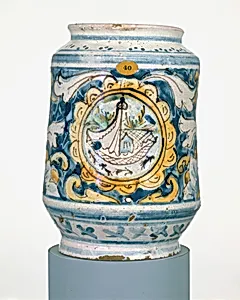
This elegant 17th-century apothecary jar, known as an *albarello*, hails from Italy—possibly the vibrant ceramic workshops of Trapani in Sicily. Shaped with a narrow waist for easy gripping and stacking in apothecary shops, it was designed to store precious medicines, herbs, or spices, often labeled with the contents in bold script. Such jars were essential tools in the pharmacies of Renaissance and Baroque Europe, blending functionality with artistry as pharmacists showcased their wares to build trust and prestige. Crafted from maiolica—tin-glazed earthenware—the jar's surface gleams with a brilliant white tin oxide layer, fired to create a smooth canvas for vivid painted decorations. The technique, perfected in Italian workshops from the 15th century onward, allowed for rich cobalt blues, greens, and yellows that wouldn't fade. Here, motifs of ships evoke Italy's seafaring heritage, perhaps nodding to Trapani's bustling port and Mediterranean trade routes that brought exotic ingredients for healing potions. Part of the Robert Lehman Collection at The Metropolitan Museum of Art, this modest 9-inch vessel (23 cm) offers a window into daily life, where medicine met maritime adventure and ceramic skill. A delightful survivor of its era!