
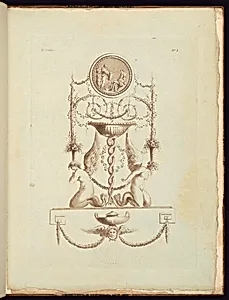
Arabesque Ornament Design
Classification
Department
Smithsonian Collection
Museum
Smithsonian American Art Museum
Credit
Purchased for the Museum by the Advisory Council
Accession Number
1921-6-336-1
Rights
Public Domain
About this artwork
Research in Progress
Art Historical Context
### Arabesque Ornament Design in 1788 by French artist Etienne de Lavalléeoussin (1735–1802), *Arabesque Ornament Design is a captivating print that exemplifies the intricate ornamental styles of late 18th-century Europe Lavallée-Poussin, active during the waning years of the Ancien Régime, specialized in decorative motifs, and this work showcases the flowing, interlaced patterns known as arabesques—curvilinear designs inspired by Islamic art and adapted into Western decorative traditions. Produced just a year before the French Revolution, it reflects a period when opulent ornamentation adorned furniture, wallpapers, and architecture, bridging Rococo elegance with emerging Neoclassical restraint. As a print, the artwork's medium—though specifics remain under research—likely allowed for precise dissemination of designs to artisans across Europe and beyond. Prints like this were invaluable tools for designers, enabling the replication of complex patterns in crafts such as textiles and metalwork. Acquired for the Smithsonian American Art Museum through the Advisory Council's purchase, it highlights transatlantic artistic exchange, bringing French refinement into an American collection. Though research continues, this piece invites visitors to appreciate the timeless allure of arabesque forms, where symmetry and fantasy intertwine, echoing centuries of cultural fusion in decorative arts. (198 words)