
Arabesque Panel Design
Classification
Bound print
Department
Smithsonian Collection
Museum
Smithsonian American Art Museum
Credit
Purchased for the Museum by the Advisory Council
Accession Number
1921-6-204-8
Rights
Public Domain
About this artwork
Research in Progress
Art Historical Context
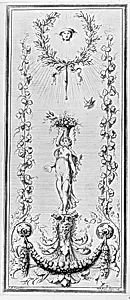
**Arabesque Panel Design** by Gilles-Paul Cauvet (French, 1731–1788), created in 1777, the exquisite ornamental designs that defined late 18th-century French decorative arts. Cauvet, a renowned Parisian designer and engraver, specialized in intricate patterns for furniture, wall panels, and interiors, bridging the lavish Rococo style with emerging Neoclassicism. This bound print, likely from one of his pattern books, captures an arabesque motif—a sinuous, interlacing arrangement of foliage, scrolls, and fantastical elements inspired by Renaissance grotesques and Islamic decorative traditions. During the reign of Louis XVI, such designs adorned opulent châteaux and urban salons, symbolizing elegance and refinement. Cauvet's work influenced cabinetmakers and architects, promoting symmetry and lightness over Rococo excess. As a bound print, it served as a practical template for artisans, highlighting the era's fusion of artistry and craftsmanship. Housed in the Smithsonian American Art Museum's collection (purchased by the Advisory Council), this piece invites us to appreciate how printed designs democratized high-style decoration. Though research continues, it stands as a testament to Cauvet's enduring legacy in shaping European taste. (178 words)