
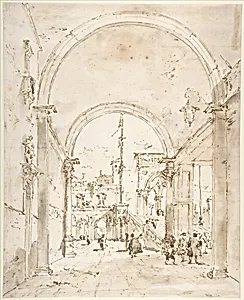
Architectural Capriccio: Grand Staircase Seen through an Archway
1712–93
Medium
Pen and brown ink, brush and brown wash, over black chalk
Dimensions
13 11/16 x 11in. (34.8 x 27.9cm)
Classification
Drawings
Department
Drawings and Prints
Museum
Metropolitan Museum of Art, New York, NY
Credit
Rogers Fund, 1937
Accession Number
37.165.79
Rights
Public Domain
Tags
Art Historical Context
Step into the whimsical world of Francesco Guardi's *Architectural Capriccio: Grand Staircase Seen through an Archway*, a delicate 18th-century drawing that captures the imagination. Guardi (1712–1793), a master of Venice's veduta tradition alongside Canaletto, here crafts a fantastical architectural fantasy—a "capriccio"—ending real Venetian grandeur with inventive flourishes. Through a shadowed archway, a majestic staircase spirals upward, evoking the opulent palaces and churches of La Serenissima, yet freed from strict realism to delight the viewer. Executed in pen and brown ink, brush and brown wash over black chalk, this 13 11/16 x 11-inch sheet showcases Guardi's virtuoso technique. The subtle layering of chalk underdrawing, precise ink lines, and atmospheric washes create depth and luminosity, drawing the eye from the dark foreground arch to the sunlit stairs beyond. Such preparatory drawings were prized in the Grand Tour era, when Northern European collectors sought evocative glimpses of Italy's architectural splendor. Housed in the Metropolitan Museum of Art's Drawings and Prints department (Rogers Fund, 1937), this work highlights Guardi's shift toward more poetic, light-filled compositions late in his career, bridging Baroque drama and emerging Romanticism. It's a portal to Venice's enduring allure, inviting you to ponder the interplay of shadow, stone, and fantasy.
About the Artist
Francesco Guardi · 1712–1793
Francesco Lazzaro Guardi (1712–1793) was born into a noble family of painters from Trentino who had settled in Venice. His father, Domenico Guardi, a minor painter trained in Vienna, died in 1716, leaving young Francesco to inherit the family workshop alongside his brothers Giovanni Antonio (Gian Antonio) and Niccolò, both artists, and sister Maria Cecilia, who married the renowned Giovanni Battis...