
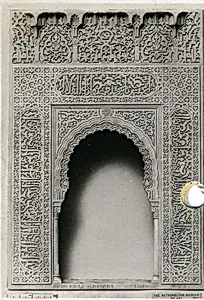
Architectural Model Based on the Alhambra
19th century (?)
Medium
Plaster colored (original stone)
Dimensions
H. 11 1/4 in. (28.6 cm) W. 8 in. (20.3 cm)
Classification
Reproductions
Department
Islamic Art
Museum
Metropolitan Museum of Art, New York, NY
Credit
Gift of Richard M. Hunt, 1885
Accession Number
85.13.2
Rights
Public Domain
Tags
Art Historical Context
This exquisite plaster model, crafted by 19th-century Spanish artist Rafael Contreras, captures the intricate architectural splendor of the Alhambra, the iconic palace complex in Granada, Spain. Measuring just 11¼ by 8 inches, the piece is meticulously colored to mimic the original stone, allowing viewers to appreciate the delicate arabesques, muqarnas vaulting, and geometric patterns synonymous with Islamic architecture from the Nasrid dynasty (13th–15th centuries). Contreras, renowned for his faithful reproductions of Moorish motifs, created such models to preserve and study the Alhambra's ornamental details amid growing European fascination with Orientalism during the 19th century. Displayed in the Metropolitan Museum of Art's Islamic Art department since its 1885 gift from architect Richard M. Hunt, this work exemplifies the era's blend of scholarship and artistry, bridging medieval Islamic ingenuity with Victorian-era revival styles. As a classified reproduction, it invites visitors to explore the Alhambra's cultural legacy—once a royal residence of Muslim rulers—up close, highlighting techniques like stucco carving that influenced global design from Spain to the Arts and Crafts movement.