
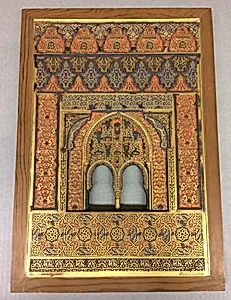
Architectural Model Based on the Alhambra
19th century (?)
Medium
Plaster colored
Dimensions
H. 16 1/2 in. (41.9 cm) W. 11 5/8 in. (29.5 cm) D. 1 1/8 in. (2.9 cm)
Classification
Reproductions
Department
Islamic Art
Museum
Metropolitan Museum of Art, New York, NY
Credit
Gift of Richard M. Hunt, 1886
Accession Number
86.15.2
Rights
Public Domain
Tags
Art Historical Context
This delicate plaster model, crafted by Spanish sculptor Rafael Contreras in 19th century, captures intricate beauty of the Alhambra, legendary Moorish palace complex in Granada, Spain. Standing just 16½ inches tall, this colored reproduction showcases the hallmark Islamic architectural details—such as ornate arabesques, muqarnas (honeycomb vaulting), and geometric patterns defined Nasrid dynasty artistry from the 13th to 15th centuries.eras, who lived and worked at the Alhambra, became renowned for producing these precise scale models, which brought the site's splendor to European audiences during a era of growing fascination with Orientalism and historic preservation. As a reproduction in The Metropolitan Museum of Art's Department of Islamic Art—gifted by architect Richard M. Hunt in 1886—this piece served as an educational tool in the 19th century, allowing scholars, designers, and collectors to study and replicate Mudéjar and Islamic motifs without traveling to Spain. The use of tinted plaster not only mimics the original stucco's vibrancy but also highlights the technical mastery required to render such filigree in miniature, preserving cultural heritage amid rapid modernization. Visitors today can appreciate how this model bridges worlds: evoking the Alhambra's poetic fusion of mathematics, nature, and faith, while reflecting 19th-century Europe's romantic revival of Islamic design influences in architecture and decorative arts.