
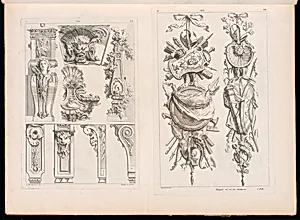
Architectural Ornament Designs
Medium
Bound print
Classification
Bound print
Department
Smithsonian Collection
Museum
Smithsonian American Art Museum
Credit
Purchased for the Museum by the Advisory Council
Accession Number
1921-6-216-9
Rights
Public Domain
About this artwork
Research in Progress
Art Historical Context
Gilles-Marie Oppenord (1672–1742), a leading French architect and designer of the Régence style—a transitional phase between the grandeur of Louis XIV's Baroque and the playful elegance of Rococo—created intricate *Architectural Ornament Designs*. Published posthumously between 1749 and 1761 as a bound print collection, this work captures Oppenord's mastery of decorative motifs, likely featuring elaborate scrolls, foliage, and fantastical elements that adorned palaces and interiors of the era. His designs influenced European architecture, blending symmetry with whimsical asymmetry. Printed engravings bound into a volume, this medium was revolutionary for disseminating ideas in the 18th century, allowing architects, craftsmen, and enthusiasts across Europe to replicate sophisticated ornamentation without direct patronage. Housed in the Smithsonian American Art Museum's collection, acquired through the Advisory Council, it exemplifies the transatlantic exchange of artistic knowledge. Though research continues, these designs offer a window into France's opulent decorative arts, inspiring generations with their fluid lines and inventive flair—perfect for envisioning the lavish salons of Versailles' successors.