
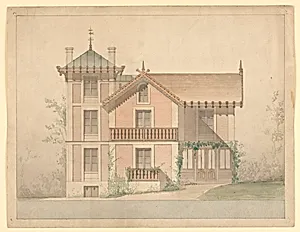
Architectural project for the house of P.J. Hetzel
Medium
architecture
Classification
architecture
Department
Smithsonian Collection
Museum
Smithsonian American Art Museum
Credit
Smithsonian American Art Museum
Accession Number
1984-116-2
Rights
Public Domain
About this artwork
Research in Progress
Art Historical Context
Eugène Emmanuel Viollet-le-Duc’s “Architectural project for the house of P.J. Hetzel,” dated 1874, offers a fascinating glimpse into the architect’s late-career explorations. As a leading French figure of the nineteenth century, Viollet-le-Duc was renowned for blending historical study with forward-looking design principles. This project, preserved in the Smithsonian American Art Museum, represents one of his domestic commissions and reflects the period’s growing interest in rational, functional residences tailored to individual clients. Though listed simply as “architecture,” the work is most likely a set of drawings or plans rather than a built structure. Such projects allowed architects like Viollet-le-Duc to experiment with spatial organization, light, and material honesty—ideas he championed in his influential writings. The Smithsonian’s ongoing research underscores how these designs continue to reveal new insights into nineteenth-century architectural thought. Visitors can appreciate the piece as both a personal commission and a window into Viollet-le-Duc’s broader legacy of merging medieval lessons with modern needs. Its presence in an American collection highlights the international reach of his ideas during his lifetime.