
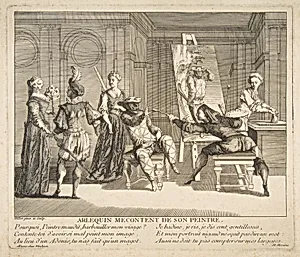
Arlequin Mecontent de Son Peintre
n.d.
Medium
Etching, second state
Dimensions
7 15/16 x 9 1/4 in. (20.1 x 23.5 cm)
Classification
Prints
Department
Drawings and Prints
Museum
Metropolitan Museum of Art, New York, NY
Credit
Charles Z. Offin Fund, 1996
Accession Number
1996.65
Rights
Public Domain
Tags
Art Historical Context
Claude Gillot’s etching *Arlequin Mécontent de Son Peintre* captures a lively scene from the commedia dell’arte tradition, in which the masked character Harlequin voices his displeasure with the artist painting his portrait. Created as a print in the second state, the work measures just under eight by nine-and-a-quarter inches, allowing the fine linear details of the figures’ gestures and expressions to remain crisp. Gillot, active in early eighteenth-century France, frequently drew upon theatrical subjects; his designs helped popularize commedia dell’arte imagery that would later influence artists such as Antoine Watteau. As an etching, the print exemplifies a medium prized for its ability to reproduce witty, narrative scenes for a growing audience of collectors. The second state indicates that Gillot refined the plate after an initial proof, sharpening contrasts and clarifying the interplay between the disgruntled Harlequin, the painter, and the surrounding figures. The work’s modest scale and crisp line work made it well suited for inclusion in albums or portfolios, spreading lighthearted commentary on artistic vanity beyond the theater stage. Acquired by the Metropolitan Museum of Art in 1996 through the Charles Z. Offin Fund, the etching preserves Gillot’s playful yet incisive view of the relationship between performer and painter. Its presence in the Department of Drawings and Prints underscores the enduring appeal of these small-scale theatrical vignettes as windows onto French cultural life in the decades before the Rococo style reached its height.
About the Artist
Claude Gillot · 1673–1722
Artist known for his elegant designs done in the Rococo manner of Audran; also for his predilection for scenes from the 'comedia dell'arte.' Few paintings survive; his work is known mainly through drawings and etchings. Comment on works: Genre; History