
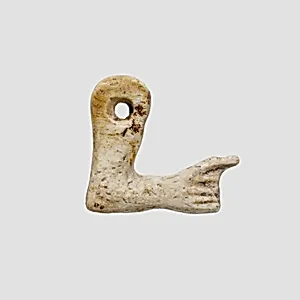
Arm amulet
Unknown Artist
ca. 2150–1950 B.C.
Medium
Ivory or bone
Dimensions
H. 1.4 × W. 1.5 × D. 0.3 cm (9/16 × 9/16 × 1/8 in.)
Classification
Amulet, arm
Period
Late Old Kingdom–Early Middle Kingdom
Department
Egyptian Art
Museum
Metropolitan Museum of Art, New York, NY
Credit
Rogers Fund, 1959
Accession Number
59.100.4
Rights
Public Domain
Art Historical Context
This delicate "Arm Amulet," crafted from ivory or bone around 2150–1950 B.C., hails from Egypt's Late Old Kingdom to Early Middle Kingdom (Dynasties 8–12). Measuring just 1.4 cm high, it's a tiny marvel, likely worn as a pendant or placed in burials to invoke protection. During this transitional era—marked by political fragmentation after the grand pyramid age and leading into the Middle Kingdom's renewal—such amulets embodied everyday spirituality amid uncertainty. In ancient Egyptian culture, amulets like this arm-shaped talisman held profound magical significance. Representing strength and vitality, the human arm symbolized action, power, and safeguarding the body, especially in the afterlife. Carved from organic materials like ivory (sourced from elephants or hippos) or bone, it showcases fine workmanship: smooth surfaces and precise anatomy reflect skilled artisans working small-scale objects with tools of copper or stone. Acquired through the Rogers Fund in 1959, this piece at the Metropolitan Museum of Art offers a glimpse into personal devotion. Though diminutive, it whispers of ancient beliefs in amulets as shields against harm, bridging the living and the divine.