
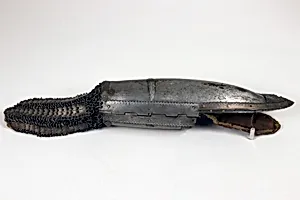
Arm Guard
Unknown Artist
18th–19th century
Medium
Steel, brass, iron, textile
Dimensions
L. 19 1/2 in. (49.5 cm); W. 3 3/4 in. (9.5 cm); Wt. 1 lb. 14.1 oz. (853.3 g)
Classification
Armor Parts-Arms & Shoulders
Culture
Indian
Department
Arms and Armor
Museum
Metropolitan Museum of Art, New York, NY
Credit
Bequest of George C. Stone, 1935
Accession Number
36.25.418
Rights
Public Domain
Art Historical Context
This exquisite arm guard, crafted in India during the 18th–19th century, exemplifies the masterful metallurgy of South Asian arms and armor. Fashioned from steel for durability, accented with brass and iron, and lined with textile for comfort, it measures 19½ inches long and weighs just under 2 pounds—light enough for agile combat yet robust enough to deflect blows. Such pieces were essential for protecting the forearm of warriors, blending functionality with the intricate workmanship typical of Indian armories. In the context of India's martial history, this guard reflects the turbulent era of regional kingdoms and the waning Mughal Empire, where cavalry and infantry relied on personalized armor. The combination of metals suggests skilled forging techniques, possibly including riveting and lamination, to balance strength and flexibility. Textile linings prevented chafing during prolonged wear, highlighting practical innovations in battlefield gear. Now housed in the Metropolitan Museum of Art's Arms and Armor Department through the 1935 bequest of George C. Stone, this artifact offers a tangible link to India's storied warrior traditions, inviting us to ponder the human stories behind its gleaming surface.