
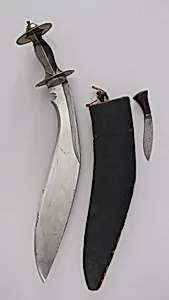
Knife (Kukri) with Sheath, Small Knife and Pouch
Unknown Artist
19th century
Medium
Steel, wood, leather
Dimensions
Knife (a); H. with sheath 17 3/8 in. (44.1 cm); H. without sheath 17 3/8 in. (44.1 cm); W. 3 in. (7.6 cm); Wt. 1 lb. 15.1 oz. (881.7 g); sheath (b); Wt. 4.1 oz. (116.2 g); small knife (c); H. 5 3/16 in. (13.2 cm); W. 1 1/4 in. (3.2 cm); Wt. 1.6 oz. (45.4 g)
Classification
Knives
Culture
Indian or Nepalese, Gurkha
Department
Arms and Armor
Museum
Metropolitan Museum of Art, New York, NY
Credit
Bequest of George C. Stone, 1935
Accession Number
36.25.828a–d
Rights
Public Domain
Art Historical Context
This exquisite 19th-century kukri knife set, complete with sheath, small knife (chakma), and pouch, hails from the Gurkha culture of India or Nepal. The kukri, with its distinctive curved blade, stands as an iconic symbol of Gurkha warriors—renowned for their bravery and skill in the British Army during the colonial era. Measuring 17 3/8 inches with its sheath, this steel blade exemplifies the practical yet formidable weaponry carried by these hill fighters, used for everything from combat to everyday tasks like chopping wood or animal husbandry. Crafted from steel, wood, and leather, the ensemble showcases masterful Nepalese or Indian metalworking techniques. The heavy blade (nearly 2 pounds) is forged for balance and durability, while the wooden hilt and leather sheath provide a secure grip and protection. The accompanying chakma and pouch highlight the set's utility, reflecting a holistic approach to armament in Gurkha society. On view in the Arms and Armor department at The Metropolitan Museum of Art (Bequest of George C. Stone, 1935), this piece not only demonstrates exceptional craftsmanship but also evokes the enduring legacy of Gurkha resilience and cultural pride.