
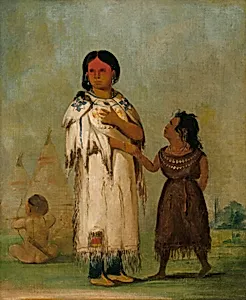
Assiniboin Woman and Child
1832
Medium
Painting
Classification
Painting
Department
Smithsonian Collection
Museum
Smithsonian American Art Museum
Credit
Smithsonian American Art Museum, Gift of Mrs. Joseph Harrison, Jr.
Accession Number
1985.66.181
Rights
Public Domain
Tags
About this artwork
“The women of this tribe are often comely, and sometimes pretty; [here is] a fair illustration of the dresses of the women and children, which are usually made of the skins of the mountain-goat, and ornamented with porcupine's quills and rows of elk's teeth.” George Catlin painted Assiniboine Woman and Child at Fort Union in the upper Midwest in 1832. (Catlin, Letters and Notes, vol. 1, no. 8, 1841; reprint 1973)
Art Historical Context
George Catlin's *Assiniboin Woman and Child* (1832) captures a tender moment from his groundbreaking travels among Native American tribes in the 19th century. Painted at Fort Union Trading Post in the upper Midwest this work is part of Catlin's ambitious project to document the lives, customs, and portraits of Indigenous peoples before rapid Western expansion altered their world forever. As a pioneering ethnographer-artist, Catlin traveled the Great Plains in the 1830s, creating over 600 paintings that form one of the earliest visual records of tribes like the Assiniboine (also spelled Assiniboin). In this oil painting, Catlin highlights the elegance of Assiniboine women's traditional attire, made from mountain-goat skins and adorned with porcupine quills and rows of elk's teeth. As he noted in his *Letters and Notes* (1841), "The women of this tribe are often comely, and sometimes pretty," praising their craftsmanship. The intimate portrayal of mother and child emphasizes cultural beauty and family bonds, rendered in Catlin's realistic style with vivid colors and attentive detail to textures. Housed in the Smithsonian American Art Museum, this piece underscores the historical urgency of Catlin's mission amid encroaching settler influence, offering visitors a window into a vanishing world and the resilience of Assiniboine traditions.
About the Artist
George Catlin · 1796–1872
George Catlin (1796–1872), born in Wilkes-Barre, Pennsylvania, to Putnam Catlin and Polly Sutton—who had been captured by Native Americans during the 1778 Battle of Wyoming—initially pursued a legal career. Trained at Litchfield Law School, he was admitted to the bar in 1819 but abandoned law after two years to study art in Philadelphia in 1823. Self-taught as a portraitist, Catlin quickly gained ...