
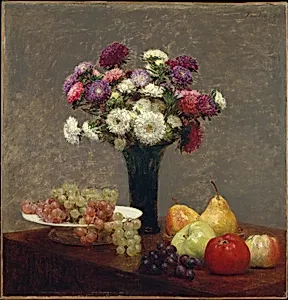
Asters and Fruit on a Table
Medium
Oil on canvas
Dimensions
22 3/8 x 21 5/8 in. (56.8 x 54.9 cm)
Classification
Paintings
Department
European Paintings
Museum
Metropolitan Museum of Art, New York, NY
Credit
The Walter H. and Leonore Annenberg Collection, Gift of Walter H. and Leonore Annenberg, 2001, Bequest of Walter H. Annenberg, 2002
Accession Number
2001.202.3
Rights
Public Domain
Tags
Art Historical Context
Henri Fantin-Latour's *Asters and Fruit on a Table* (8) is a masterful example of 19th-century French still life painting, the quiet elegance of everyday abundance. Rendered in oil on canvas, this work measures 22 3/8 x 21 5/8 inches and depicts a tabletop arrangement of vibrant asters, plump grapes, ripe apples, and pears. artist, a Paris-based realist known for his precise, almost photographic depictions of flowers and fruit, draws on the Dutch Golden Age tradition of masters like Chardin and Willem Kalf, infusing simple objects with profound visual poetry. Fantin-Latour's technique shines in his meticulous attention to texture and light: the velvety petals of the asters contrast with the glossy skins of the fruit, while subtle shadows and reflections create a trompe l'œil effect, inviting viewers to reach out and touch. Created during the Second Empire era, when Realism challenged Romanticism by celebrating the tangible world, this painting reflects a cultural appreciation for nature's fleeting beauty amid rapid industrialization. Now part of The Metropolitan Museum of Art's European Paintings collection, gifted by the Annenbergs, it exemplifies how still lifes transcend mere decoration to evoke contemplation and sensory delight.
About the Artist
Henri Fantin-Latour · 1836–1904
Ignace Henri Jean Théodore Fantin-Latour was born on January 14, 1836, in Grenoble, France, to portrait painter Théodore Fantin-Latour, who gave him his earliest drawing lessons. The family relocated to Paris in 1841, where in 1850, at age 14, he enrolled in the École de Dessin, studying under Horace Lecoq de Boisbaudran, whose innovative memory-based method of drawing from observation profoundly ...