
au pays de la soif et de la peur
1923
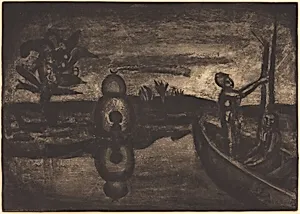
Medium
aquatint, roulette, and drypoint over heliogravure
Classification
Portfolio
Department
CG-W
Museum
National Gallery of Art, Washington, D.C.
Credit
Rosenwald Collection
Accession Number
1950.1.167
Rights
Public Domain
Art Historical Context
Georges Rouault's *Au pays de la soif et de la peur* (In the Land of Thirst Fear), created in 1923, the artist's profound Expressionist vision amid the lingering shadows of World War I A French painter and printmaker influenced by Fauvism andism, Rouault was renowned for his raw, emotive style—thick black contours, vivid colors, and themes of human suffering, spirituality, and social critique. This work, part of a portfolio, evokes desolation and existential dread, reflecting Europe's post-war trauma and spiritual thirst. The medium—aquatint, roulette, and drypoint layered over heliogravure—showcases Rouault's innovative printmaking. Heliogravure provided a photomechanical base for tonal depth, while the hand-applied techniques added gritty texture and personal intensity, blending industrial precision with artisanal passion. This hybrid approach amplified the work's haunting mood, making it a pinnacle of early 20th-century graphic art. Housed in the National Gallery of Art's Rosenwald Collection (Department CG-W), this piece invites visitors to ponder Rouault's unflinching gaze on humanity's darker impulses, a timeless reminder of resilience amid fear.
About the Artist
Georges Rouault · 1871–1958
Georges-Henri Rouault was born on May 27, 1871, in a Paris cellar during the violent "Bloody Week" of the Paris Commune, when a stray shell destroyed his family's home in the working-class Belleville district. Raised by a carpenter father who worked at the Pleyel piano factory and a grandfather who collected prints by Honoré Daumier, Rembrandt, Courbet, and Manet, Rouault showed early artistic pro...