
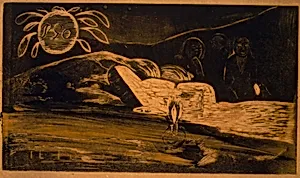
Te Po
1893–94
Medium
Woodcut printed in color on wove paper lined with silk
Dimensions
8 1/4 x 14 1/4 in. (21 x 36.2 cm): block 11 x 16 1/2 in. (27.6 x 41.9 cm): paper
Classification
Prints
Department
Drawings and Prints
Museum
Metropolitan Museum of Art, New York, NY
Credit
Harris Brisbane Dick Fund, 1936
Accession Number
36.6.12
Rights
Public Domain
Tags
Art Historical Context
**Te Po (The Night)**, created by Paul Gauguin 1893 and 1894, captures the artist's fascination with Tahitian life during his first stay on the island. Gauguin, a leading Post-Impressionist, inspiration beyond Europe, immersing himself in Polynesian to evoke mystery and spirituality. This wood, titled in Maori meaning "The Night," reflects his symbolic style, blending abstraction with dreamlike scenes of nocturnal figures—likely island women under a starry sky—flattened into bold, rhythmic forms that prioritize emotion over realism. Printed in color on wove paper lined with silk, *Te Po* showcases Gauguin's innovative printmaking. He hand-carved the woodblocks and experimented with layered colors, drawing from Japanese ukiyo-e influences to create vibrant, textured effects. The silk lining adds a tactile luxury, rare for prints, enhancing its exotic allure. Part of his experimental *Noa Noa* series, it marked a shift toward non-Western abstraction in Western art. Today, housed in the Metropolitan Museum of Art's Drawings and Prints department (acquired via the Harris Brisbane Dick Fund in 1936), *Te Po* remains a testament to Gauguin's pioneering role in modern printmaking and cultural fusion, inviting visitors to ponder the night's enigmatic beauty. (198 words)
About the Artist
Paul Gauguin · 1848–1903
Paul Gauguin (1848-1903) was a French Post-Impressionist painter whose bold experiments with color, form, and subject matter made him one of the most influential figures in the transition from 19th-century art to modernism. His rejection of European civilization for the perceived authenticity of 'primitive' cultures established an archetype of artistic exile that continues to resonate. Gauguin's ...