
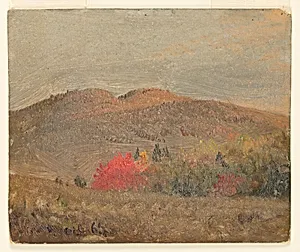
Autumn Landscape, Vermont
October 1865
Classification
landscapes
Department
Smithsonian Collection
Museum
Smithsonian American Art Museum
Credit
Gift of Louis P. Church
Accession Number
1917-4-710-b
Rights
Public Domain
About this artwork
Research in Progress
Art Historical Context
Frederic Edwin Church, a leading figure of the Hudson River School, painted *Autumn Landscape, Vermont* October 1865, the vibrant hues of New England's fall foliage. This American artist (1826–1900) was renowned for his luminous, detailed depictions of the natural world, often evoking sublime beauty of the American wilderness. Created just months after the Civil War's end, the work reflects a era when landscapes served as symbols of national renewal and divine harmony amid post-war reflection. Church's style emphasized meticulous observation and dramatic lighting, hallmarks of the Hudson River School movement, which celebrated America's untamed landscapes as expressions of Manifest Destiny and spiritual awe. Though the medium is unknown, such paintings typically employed oil on canvas to achieve rich color and atmospheric depth, inviting viewers to immerse in nature's grandeur. This Vermont scene likely showcases Church's skill in rendering seasonal transitions, with fiery reds, golds, and oranges against verdant hills. Now in the Smithsonian American Art Museum's Smithsonian Collection—gifted by Louis P. Church—this piece offers a serene portal to 19th-century America. Research continues to uncover more about its creation, but it endures as a testament to Church's enduring legacy in American landscape art. (198 words)