
Axel Herman Haig III
1884
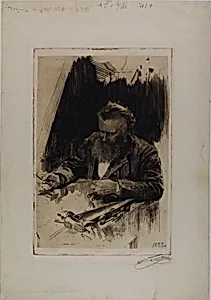
Medium
Etching on ivory wove paper
Dimensions
Image/plate: 38.8 × 25.9 cm (15 5/16 × 10 1/4 in.); Sheet: 56.4 × 39.4 cm (22 1/4 × 15 9/16 in.)
Classification
engraving
Department
Prints and Drawings
Museum
Art Institute of Chicago
Accession Number
41504
Rights
Public Domain
Art Historical Context
**Axel Herman Haig** is a striking 1884 etching by Swedish artist Anders Zorn (1860–1920), capturing the likeness of fellow printmaker Axel Herman Haig, a renowned Scottish etcher known for his dramatic marine scenes. Created when Zorn was in his mid-20s, this work exemplifies his early mastery of portraiture, rendered on ivory wove paper with an size of 38.8 × 25.9 cm. As the third in a series of portraits of Haig, it reflects Zorn's fascination with fellow artists and his burgeoning international connections in Europe's vibrant art scene. Zorn's etching technique shines here: using acid to bite intricate lines into a metal plate, he achieved remarkable tonal depth and texture, evoking the subject's thoughtful gaze and the subtle play of light on skin and fabric. Printed on high-quality ivory wove paper, the sheet measures 56.4 × 39.4 cm, allowing for generous margins that highlight the print's precision. Etchings like this were revolutionary for their accessibility, bridging fine art with reproductive media and making Zorn's realistic style—rooted in Impressionist light effects and Nordic precision—available beyond elite patrons. Housed in the Art Institute of Chicago's Prints and Drawings department and classified as an engraving (a broad intaglio category), this piece underscores Zorn's pivotal role in late-19th-century printmaking, blending technical innovation with psychological insight for enduring appeal.
About the Artist
Anders Zorn · 1860–1920
Anders Zorn (1860–1920), one of Sweden's most celebrated artists, was born on February 18 in Utmeland near Mora in Dalarna, and raised on his maternal grandparents' farm in the nearby hamlet of Yvraden. Displaying prodigious talent from a young age, he attended school in Mora Strand until age twelve, followed by secondary grammar school in Enköping, where he excelled in drawing people and horses. ...