
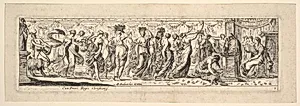
Bacchanal
1615–42
Medium
Etching
Dimensions
Sheet: 3 11/16 x 10 3/4 in. (9.3 x 27.3cm) Plate: 2 3/4 x 9 13/16 in. (7 x 24.9cm)
Classification
Prints
Department
Drawings and Prints
Museum
Metropolitan Museum of Art, New York, NY
Credit
Harris Brisbane Dick Fund, 1928
Accession Number
28.91.15
Rights
Public Domain
Tags
Art Historical Context
**Bacchanal by Pierre Breiette** Step into the exuberant world of *Bacchanal*, a etching by French artist Pierre Brebiette created between 1615 1642. This intimate print (sheet: 3 11/16 x 10 3/4 in.) captures a lively mythological revelry, featuring men and women in spirited celebration alongside sheep, evoking the ancient Roman festivals honoring Bacchus, the god of wine. Brebiette, active during the transition from Mannerism to Baroque in early 17th-century France and Italy, delighted in such dynamic scenes of joy and abandon, blending classical mythology with pastoral charm. Etching, Brebiette's chosen medium, was revolutionary for its time, allowing artists to draw directly onto a metal plate with acid-resistant ground, then etch fine lines with mordant for intricate details and tonal effects. This technique made complex compositions like this bacchanal accessible through affordable prints, popularizing elite themes among a broader audience. Housed in the Metropolitan Museum of Art's Drawings and Prints department (Harris Brisbane Dick Fund, 1928), it exemplifies the era's printmaking prowess. Today, *Bacchanal* invites us to ponder the timeless allure of festivity, reminding visitors of how 17th-century artists like Brebiette bridged antiquity and the Renaissance spirit through masterful, miniature artistry.
About the Artist
Pierre Brebiette · 1598–1642
Pierre Brébiette (c. 1598–c. 1642) was a French painter and etcher whose elegant, sensuous treatment of classical mythology and allegory earned him a significant reputation in early seventeenth-century Paris. Born in Mantes-sur-Seine, Brébiette traveled to Italy as a young man and lived and worked in Rome from around 1617 to approximately 1625, absorbing the influences of ancient sculpture, Renais...