
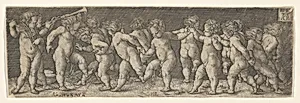
Fifteen Nude Children Dancing
Medium
Engraving
Dimensions
Sheet: 2 1/16 × 6 1/2 in. (5.3 × 16.5 cm)
Classification
Prints|Ornament & Architecture
Department
Drawings and Prints
Museum
Metropolitan Museum of Art, New York, NY
Credit
Purchase, Joseph Pulitzer Bequest, 1917
Accession Number
17.50.55
Rights
Public Domain
Tags
Art Historical Context
In the lively engraving *Fifteen Nude Children* from 1535, German artist Heinrich Aldegrever—often associated with the "Little Masters" of Northern Renaissance printmaking—captures a whimsical procession of playful figures. Likely inspired by or reproducing motifs from Italian engraver Marcantonio Raimondi, tiny sheet (just over 2 by 6 inches) brims with energy: nude children frolic in a frieze-like arrangement, some dancing gleefully while others play musical instruments, evoking the joyous spirit of Renaissance ornamentation. Engraving, Aldegrever's specialty, allowed for intricate lines and reproducible designs on a small scale, making such prints ideal for decorative arts like jewelry, book illustrations, or architectural patterns. Classified under Prints, Ornament & Architecture at The Metropolitan Museum of Art, it reflects the era's fascination with classical grotesques and putti—chubby, winged children symbolizing innocence and vitality—blending German precision with Italian grace. Acquired through the Joseph Pulitzer Bequest in 1917, this work highlights the Renaissance revival of antique motifs, inviting viewers to appreciate the delicate burin work that brings these miniature revelers to life, a testament to printmaking's role in disseminating artistic ideas across Europe.
About the Artist
Heinrich Aldegrever|Marcantonio Raimondi · 1502–1561
Heinrich Aldegrever, born in 1502 in Paderborn, Westphalia, to parents Herman and Katherine Trippenmeker—a family of clog-makers known by the dialect name Trippenmecker—emerged as a multifaceted artist in the German Renaissance. His early training remains undocumented, though he likely apprenticed in a Soest goldsmith's workshop after relocating there around 1525, where he joined the painters' gui...