
Belt Buckle
Unknown Artist
late 6th–7th century
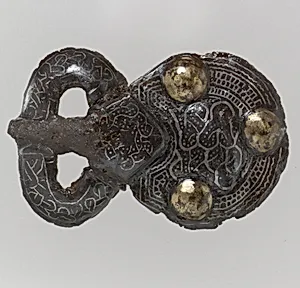
Medium
Iron inlaid with silver, iron rivets with heads of copper alloy
Dimensions
Overall: 3 1/2 x 1/2 x 2 1/4 in. (8.9 x 1.3 x 5.7 cm)
Classification
Metalwork-Iron
Culture
Frankish
Department
Medieval Art
Museum
Metropolitan Museum of Art, New York, NY
Credit
Gift of J. Pierpont Morgan, 1917
Accession Number
17.193.98
Rights
Public Domain
Art Historical Context
This exquisite Frankish belt buckle, to the late 6th–7th century, exemplifies the craftsmanship of early medieval Europe during the Merovingian period Crafted from iron inlaid with silver and secured by iron rivets topped with copper alloy heads, measures a compact 3 1/2 x 1/2 x 2 1/4 inches. As a functional accessory, it would have fastened belts on clothing or weaponry, blending everyday utility with decorative flair. Frankish metalworkers were renowned for their technical skill, and this piece highlights their mastery of inlay techniques—likely involving grooves cut into the iron base, filled with silver for contrasting shine and durability. The copper alloy rivet heads add a touch of color and structural reinforcement, showcasing resourcefulness with local alloys. Such buckles often denoted social status among the warrior elite of the Frankish kingdoms, which dominated much of western Europe after the fall of Rome. A generous gift from J. Pierpont Morgan in 1917, this artifact now resides in The Metropolitan Museum of Art's Medieval Art department. It offers a tangible glimpse into a transformative era, where barbarian artistry evolved into the foundations of medieval splendor.