
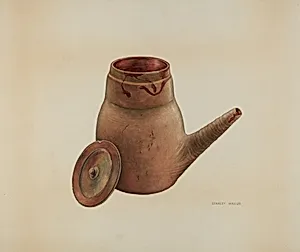
Batter Jug
c. 1938
Medium
watercolor, graphite, and colored pencil on paper
Dimensions
overall: 35.4 x 43.6 cm (13 15/16 x 17 3/16 in.)
Classification
Index of American Design
Department
CG-W
Museum
National Gallery of Art, Washington, D.C.
Credit
Index of American Design
Accession Number
1943.8.12671
Rights
Public Domain
Art Historical Context
**Batter Jug** by Stanley Mazur (c. 1938) is a captivating rendering of a traditional American ceramic vessel, meticulously captured in watercolor, graphite, and pencil on paper (35.4 x 43.6 cm). Part of National Gallery of Art's Index of American Design, this work showcases a humble yet essential household item—a sturdy jug designed for mixing batters in everyday cooking, reflecting the practical ingenuity of early American craftsmanship. Created during the Great Depression as part of the Art Project under the Works Progress Administration (WPA), Index of American Design (1935–1942) employed artists like Mazur to document the nation's folk art and decorative traditions through precise, vibrant illustrations. These renderings preserved vanishing cultural artifacts, celebrating regional pottery styles and the democratic spirit of American design amid economic hardship. Mazur's masterful use of mixed media brings the jug's earthy textures, subtle glazes, and functional form to life: graphite for fine details, watercolor for luminous color, and colored pencil for depth and precision. This technique not only highlights the object's historical role in colonial and frontier kitchens but also underscores the Index's legacy in safeguarding America's material heritage for future generations. A delightful glimpse into our shared past! (198 words)
About the Artist
Stanley Mazur · 1903–1978
**Stanley Mazur (1903–1978)** was an American artist best known for his meticulous watercolor renderings created as part of the Index of American Design, a Works Progress Administration (WPA) initiative during the Great Depression era. This ambitious project commissioned artists across the United States to document everyday folk art objects, crafts, and tools that embodied the nation's cultural he...